Want to build stunning websites but don’t know where to start? Breaking into frontend development feels overwhelming with so many tools, languages, and frameworks available. This complete roadmap shows you exactly what to learn, in what order, and how to land your first role without wasting time on outdated methods.
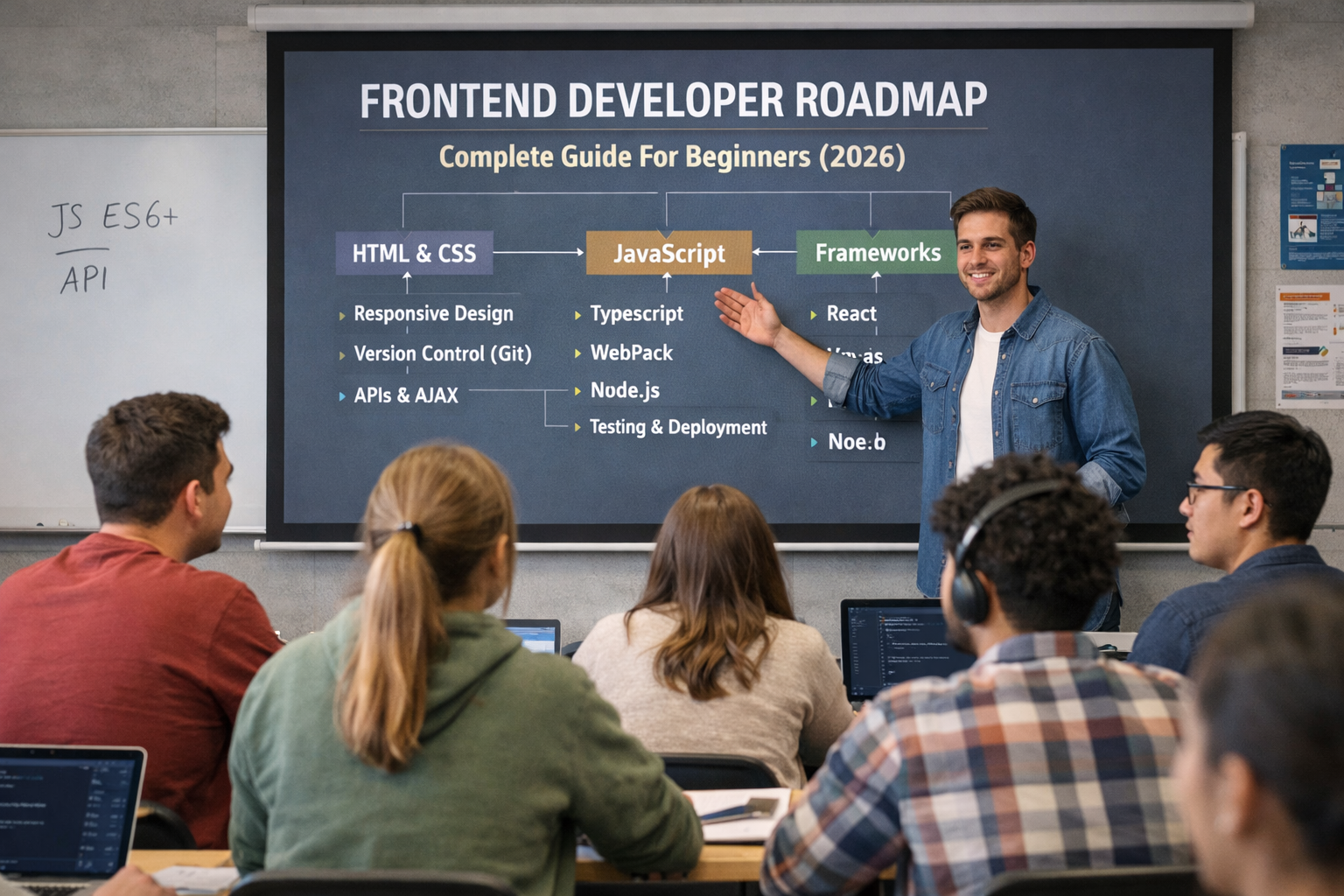
Frontend development involves creating the visual and interactive parts of websites using HTML, CSS, and JavaScript. Beginners should start with HTML basics, progress to CSS styling, master JavaScript fundamentals, learn a modern framework like React, and build real projects. Following a structured web development course or roadmap ensures you learn skills employers actually need in 2026.
What Is Frontend Development?
Frontend development means building everything users see and interact with on websites and web applications. This includes buttons, menus, forms, animations, layouts, and responsive designs. Frontend developers transform design mockups into functional code that runs in web browsers. They work with three core technologies: HTML for structure, CSS for styling, and JavaScript for interactivity.
Key responsibilities include:
- Creating responsive layouts that work on all devices
- Implementing interactive features and user interfaces
- Optimizing website performance and load times
- Ensuring cross-browser compatibility
- Collaborating with designers and backend developers
Why Learn Frontend Development in 2026?
The demand for skilled Frontend Development continues growing rapidly across all industries. Companies need developers who can create fast, accessible, and mobile-friendly web experiences. Remote work opportunities are abundant, salaries remain competitive, and the barrier to entry is lower than many tech careers.
Benefits of becoming a frontend developer:
- High demand with 200,000+ job openings globally
- Average starting salary of $60,000–$85,000
- Flexible remote work options
- Creative and technical skill combination
- Clear career progression path
- Freelance and contract opportunities
Step-by-Step Frontend Developer Roadmap
Follow this proven path to go from complete beginner to job-ready developer in 6–12 months.
Step 1: Master HTML Fundamentals (2–3 weeks)
Start with HTML, the skeleton of every website. Learn semantic tags, forms, tables, lists, and document structure. Practice creating basic web pages with headings, paragraphs, images, and links. Focus on writing clean, accessible code from the beginning.
What to learn:
- Semantic HTML5 elements (header, nav, article, section)
- Forms and input types
- Tables and lists
- Accessibility basics (alt text, ARIA labels)
Step 2: Learn CSS and Responsive Design (4–6 weeks)
CSS transforms plain HTML into beautiful, professional-looking websites.
Master selectors, box model, flexbox, and grid layouts. Learn responsive design principles using media queries. Practice styling real website components like navigation bars, cards, and footers.
Essential CSS skills:
- Flexbox and CSS Grid for layouts
- Responsive design with media queries
- CSS variables and custom properties
- Transitions and basic animations
- Mobile-first design approach
Step 3: Build JavaScript Proficiency (8–10 weeks)
JavaScript brings websites to life with interactivity and dynamic content. Start with variables, data types, functions, and control structures. Progress to DOM manipulation, event handling, and asynchronous programming. Build interactive features like image sliders, form validation, and dynamic content loading.
Core JavaScript concepts:
- Variables, functions, and loops
- DOM manipulation and event listeners
- ES6+ features (arrow functions, destructuring, modules)
- Asynchronous JavaScript (promises, async/await)
- API integration and fetch requests
Step 4: Learn Version Control with Git (1–2 weeks)
Every developer needs to track code changes and collaborate effectively.
Master basic Git commands for committing, branching, and merging. Create a GitHub account to showcase your projects. Learn pull requests and collaboration workflows used in professional teams.
Step 5: Choose and Master a Frontend Framework (8–12 weeks)
Modern frontend development relies heavily on frameworks for building complex applications. React remains the most popular choice, followed by Vue and Angular. Pick one framework and build multiple projects with it. Learn component-based architecture, state management, and routing.
Framework recommendations:
- React: Most job opportunities, large community
- Vue: Easier learning curve, growing adoption
- Angular: Enterprise applications, full-featured
Step 6: Explore Build Tools and Development Workflow (2–3 weeks)
Professional developers use tools to streamline their workflow. Learn package managers (npm, yarn), bundlers (Webpack, Vite), and task runners. Understand how to set up development environments, manage dependencies, and optimize production builds.
Step 7: Build a Professional Portfolio (Ongoing)
Your portfolio proves your skills to potential employers.
Create 4–6 projects showcasing different skills and complexity levels. Include responsive designs, API integrations, and framework-based applications. Write clear documentation and deploy projects to platforms like Vercel or Netlify.
Portfolio project ideas:
- Responsive landing page
- Weather application using API
- Task management application
- E-commerce product page
- Portfolio website itself
- Social media dashboard
Essential Skills Beyond Coding
Technical skills alone won’t make you a great frontend developer.
Develop problem-solving abilities by debugging code and researching solutions independently. Learn design fundamentals to understand spacing, typography, and color theory. Practice communication skills for working with teams and explaining technical concepts.
Soft skills that matter:
- Problem-solving and debugging
- Time management and project planning
- Basic design principles
- Communication and collaboration
- Continuous learning mindset
- Attention to detail
Best Resources for Learning Frontend Development
Quality learning resources make your journey faster and more effective. A structured web development course provides guided learning paths and prevents common beginner mistakes. Combine paid courses with free resources for comprehensive knowledge.
Recommended learning platforms:
- free Code Camp: Free, project-based curriculum
- The Odin Project: Complete full-stack path
- Scrimba: Interactive video tutorials
- Frontend Mentor: Real-world design challenges
- MDN Web Docs: Comprehensive reference documentation
- YouTube channels: Traversy Media, Web Dev Simplified

Real Example: Sarah’s Journey From Beginner to Hired
Sarah started learning frontend development in January with zero coding experience.
She followed this roadmap, spending 2–3 hours daily after her retail job. By March, she completed HTML, CSS, and JavaScript fundamentals. In April, she started learning React through a web development course on Udemy. She built five portfolio projects between May and July, including a recipe finder app and a budget tracker.
Sarah applied to 40 junior positions in August, received 8 interviews, and accepted a remote frontend developer role in September with a $68,000 salary. Her success came from consistent daily practice, building real projects, and actively participating in developer communities on Discord and Twitter.
Common Mistakes to Avoid
Many beginners slow their progress by making these preventable errors.
Don’t jump to frameworks before mastering JavaScript fundamentals. Avoid tutorial hell by building projects independently after learning concepts. Don’t ignore responsive design or accessibility from the start.
Mistakes that waste time:
- Learning too many technologies simultaneously
- Skipping fundamentals to reach frameworks faster
- Only following tutorials without building original projects
- Neglecting Git and version control early
- Ignoring mobile responsiveness
- Not seeking feedback on code quality
- Perfectionism preventing project completion
- Avoiding documentation and problem-solving practice
Frontend Development vs Backend Development
| Aspect | Frontend Development | Backend Development |
| Focus | User interface and experience | Server, database, application logic |
| Languages | HTML, CSS, JavaScript | Python, Java, Node.js, PHP |
| Tools | React, Vue, Tailwind CSS | Express, Django, databases |
| Visibility | Visible to users | Hidden from users |
| Skills | Design sense, responsiveness | Data structures, algorithms |
| Debugging | Browser developer tools | Server logs, debugging tools |
How Long Does It Take to Become Job-Ready?
Most dedicated beginners reach job-ready status in 6–12 months. Your timeline depends on daily study hours, prior experience, and learning approach. Studying 2–3 hours daily typically results in job readiness within 8–10 months. Full-time learners can achieve this in 4–6 months.
Realistic timelines:
- Part-time (10–15 hours/week): 10–12 months
- Consistent daily (2–3 hours): 6–8 months
- Full-time (6–8 hours): 4–6 months
- Intensive bootcamp: 3–4 months
Landing Your First Frontend Developer Job
Job searching requires strategy beyond just technical skills. Tailor your resume to highlight relevant projects and technologies. Apply to 5–10 positions daily, including junior and entry-level roles. Network on LinkedIn, attend virtual meetups, and contribute to open-source projects.
Job search strategies:
- Build projects that solve real problems
- Contribute to GitHub repositories
- Network in developer communities
- Create content (blog posts, tutorials)
- Practice coding interviews on Leet Code
- Prepare a strong portfolio website
- Apply to small companies and startups first
Key Takeaways
- Start with HTML, CSS, and JavaScript before learning frameworks
- Spend 6–12 months building consistent learning habits
- Create 4–6 portfolio projects demonstrating different skills
- Join developer communities for support and networking
- Focus on problem-solving and building real applications
- Apply for jobs once you complete 3–4 solid projects
The frontend development roadmap starts with HTML, CSS, and JavaScript fundamentals, progresses to modern frameworks like React, and emphasizes building real projects. Complete a structured web development course, create a strong portfolio, and develop both technical and soft skills to land your first developer role within 6–12 months of consistent practice.
Conclusion
Becoming a frontend developer in 2026 requires commitment, but the path is clear and achievable. Follow this roadmap step-by-step, build projects that showcase your skills, and stay consistent with daily practice. The web development industry needs talented developers who understand both code and user experience. Your journey starts with that first HTML tag—take action now and join thousands of developers building the web.
FAQs
Q1: Do I need a computer science degree for frontend development?
No degree is required. Most employers prioritize portfolios and practical skills over formal education. Many successful frontend developers are self-taught or bootcamp graduates.
Q2: Which frontend framework should beginners learn first?
React is recommended due to its job market demand and extensive learning resources. Vue offers an easier learning curve if React feels overwhelming initially.
Q3: How many projects should my portfolio include?
Include 4–6 quality projects demonstrating different skills. Focus on variety: responsive design, API integration, framework usage, and problem-solving complexity.
Q4: Can I learn frontend development while working full-time?
Absolutely. Dedicate 1–2 hours daily for consistent progress. Many developers successfully transitioned careers while maintaining full-time jobs through disciplined evening and weekend study.
Q5: What salary can entry-level front-end developers expect?
Entry-level salaries range from $50,000–$75,000 depending on location and company size. Remote positions often offer competitive rates regardless of geographic location.
Q6: Should I learn CSS frameworks like Bootstrap or Tailwind?
Learn CSS fundamentals first, then explore frameworks. Tailwind CSS is highly relevant in 2026, but understanding core CSS principles remains essential for problem-solving and customization.