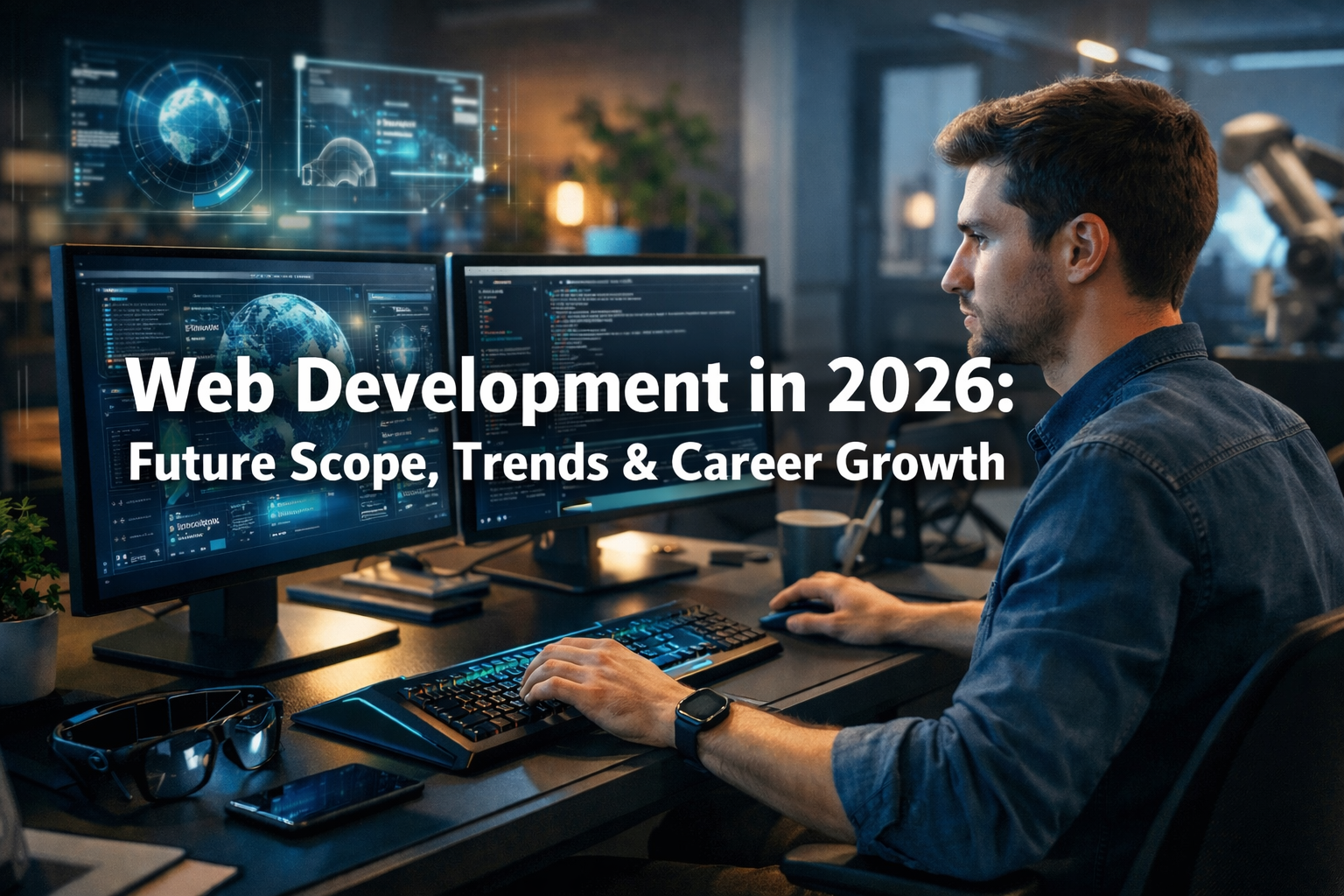
Feeling overwhelmed by the pace of change in tech? You’re not alone. The world of building websites and applications is evolving faster than ever. This guide breaks down exactly what’s coming, the skills that will matter, and how you can build a thriving career in this dynamic field. The future scope for Web Development is exceptionally strong, driven by AI-powered tools, immersive web experiences, and a demand for faster, more personalized sites. Career growth will favor developers who master full-stack fundamentals while specializing in emerging areas like edge computing and performance optimization. For hands-on training, a structured web development course in jaipur can provide the essential foundation to enter this high-opportunity field.
What Are the Key Web Development Trends for 2026?
The direct answer is a shift towards smarter, faster, and more connected user experiences. Core technologies will focus on performance, personalization, and immersion. You will see a move beyond traditional frameworks. Developers will integrate advanced APIs and leverage the edge network to serve content from locations closer to the user. This drastically reduces load times. The focus is on creating seamless interactions that feel instant and intuitive, regardless of a user’s device or connection.
- AI-Integrated Development: Code assistants and testing tools will become standard, helping write cleaner code and catch errors faster.
- The Rise of the Edge: More logic and content delivery will move from central servers to distributed edge networks for lightning speed.
- Progressive Web Apps (PWAs): These will function more like native mobile apps, with offline capabilities and push notifications.
- Web3 & Decentralized Elements: Certain sectors may incorporate blockchain for features like secure verification, though it won’t be ubiquitous.
What is the Future Career Growth for Developers?
Career prospects are expanding beyond traditional developer roles. Growth lies in specialization and the ability to solve complex performance and user experience problems. Companies value developers who can directly impact business goals like conversion rates and user retention. This means roles are becoming more strategic. You could grow into positions focused entirely on site speed, accessibility, or core front-end interactivity.
- High-Demand Specializations: Performance Engineer, Accessibility Specialist, Dev Sec Ops Engineer.
- Leadership Paths: Progress from Senior Developer to Tech Lead, Engineering Manager, or Solutions Architect.
- Freelance & Remote Work: The global demand for skilled developers continues to support robust freelance and remote opportunities.
Which Essential Skills Should You Learn Now?
Build a rock-solid foundation in core web languages and modern frameworks. This foundation will allow you to adapt to any new tool or trend that emerges. Expertise in HTML, CSS, and JavaScript is non-negotiable. On top of this, understand a modern framework like React or Vue. Crucially, learn how to optimize every aspect of a website—from image delivery to code splitting—because speed will remain a top ranking and user retention factor.
- Core Triad: Advanced HTML5, CSS3 (Grid, Flexbox), and modern JavaScript (ES6+).
- Framework Proficiency: Master one major framework (e.g., Next.js, React) and its ecosystem.
- Performance & Core Web Vitals: Learn caching, lazy loading, and rendering optimization.
- Back-End Basics: Understand server-side concepts, APIs, and at least one server language (Node.js, Python).

A Step-by-Step Path to Start Your Development Career
This is a practical, five-step plan to go from beginner to job-ready.
- Master the Absolute Basics. Spend your first weeks deeply learning HTML and CSS. Build simple, static web pages to solidify your understanding.
- Add Interactivity with JavaScript. Learn vanilla JavaScript to manipulate web pages. Create dynamic elements like image sliders and form validators.
- Choose and Learn a Framework. Select a popular framework like React. Learn its core principles (components, state, props) by rebuilding your previous projects with it.
- Learn Back-End Fundamentals. Understand how servers work. Use Node.js with Express to build simple APIs and learn how to connect your front-end to a database.
- Build a Portfolio and Deploy. Create 3-4 substantial projects that solve real problems. Deploy them using platforms like Vercel or Netlify. This portfolio is your key credential.
Real-World Example: Building a Fast E-Commerce Product Page
Consider an online store. In 2026, a developer’s goal is to make the product page load instantly. They would use a framework like Next.js for server-side rendering, ensuring the initial HTML is ready immediately. Product images would be served in modern formats like WebP from a global CDN. Interactive elements, like the “Add to Cart” button, would be hydrated with JavaScript only after the core content is visible. This approach prioritizes the user’s immediate need—seeing the product—over loading every script at once, leading to higher engagement and sales.
Common Mistakes to Avoid
Many beginners focus on the wrong things, slowing their progress significantly.
The biggest error is jumping into advanced frameworks without understanding the core web languages they are built upon. This creates fragile knowledge. Another major mistake is neglecting website speed and mobile responsiveness during development, which are critical for success.
- Skipping Fundamentals: Don’t learn React before you are comfortable with pure JavaScript.
- Ignoring Performance: Writing bulky, unoptimized code that leads to slow site speeds.
- Forgetting Mobile Users: Designing and testing only on a desktop computer.
- Not Using Version Control: Failing to learn Git and GitHub from the very start.
Key Takeaways for Your Journey
- The demand for skilled developers is set to grow, especially for those who specialize.
- Core skills in JavaScript and performance optimization will be your most valuable assets.
- Learning is continuous; the ability to adapt is part of the job.
- A strong portfolio of real projects is more important than just credentials.
- Consider local training options, such as a comprehensive web development course in jaipur, to get structured, mentor-led practice.
- Always build with the end-user’s speed and experience as the top priority.
Web Development remains a high-growth career path focused on creating faster, smarter user experiences. Success requires core programming skills, adaptability to new tools, and a specialization in areas like performance. Structured training, available locally such as through a web development course in jaipur, can effectively jumpstart this career by providing hands-on, project-based learning.
Conclusion
The path ahead for web development is exciting and full of potential. By focusing on enduring principles, embracing continuous learning, and building practical skills, you can position yourself at the forefront of this digital evolution. Start with a strong foundation, work on tangible projects, and step confidently into a future where your ability to build for the web is more valuable than ever.
Frequently Asked Questions (FAQs)
1. Is web development still a good career in 2026?
Absolutely. The demand for creating and maintaining digital experiences across businesses, education, and entertainment ensures strong career opportunities and growth.
2. What is the most important programming language to learn?
JavaScript is the most critical language for modern web development. It runs on both the client-side and server-side, making it essential for full-stack development.
3. How long does it take to become job-ready?
With focused, consistent study, you can gain the fundamental skills for an entry-level position in approximately 6 to 12 months. Building a solid portfolio is key to this timeline.
4. Do I need a computer science degree?
No, it is not a strict requirement. Many successful developers are self-taught or come from coding bootcamps. Employers primarily look for demonstrable skills and a strong portfolio.
5. What’s the difference between front-end and back-end development?
Front-end development involves everything the user sees and interacts with directly in their browser. Back-end development involves the server, database, and application logic that powers the site from behind the scenes.
6. How do I stay updated with the latest trends and technologies?
Follow key industry blogs, participate in developer communities on GitHub or Twitter, and regularly build small test projects with new libraries or tools to understand them practically.