Search is evolving faster than ever, and traditional SEO alone is no longer enough to stay competitive. With the rise of AI-driven search engines, voice assistants, and generative platforms, businesses must now adapt to AEO (Answer Engine Optimization) and GEO (Generative Engine Optimization)—the next generation of search strategies. These new approaches focus not just on ranking websites, but on delivering direct answers, building authority, and appearing in AI-generated responses.
For students and professionals looking to stay ahead, enrolling in an seo course in jaipur at a reputed digital marketing institute in jaipur can help you understand this transformation in depth. From mastering search engine fundamentals to learning how AI influences content visibility, modern digital marketing training equips you with the skills needed to thrive in this new search landscape.
What do SEO, AEO, and GEO mean?
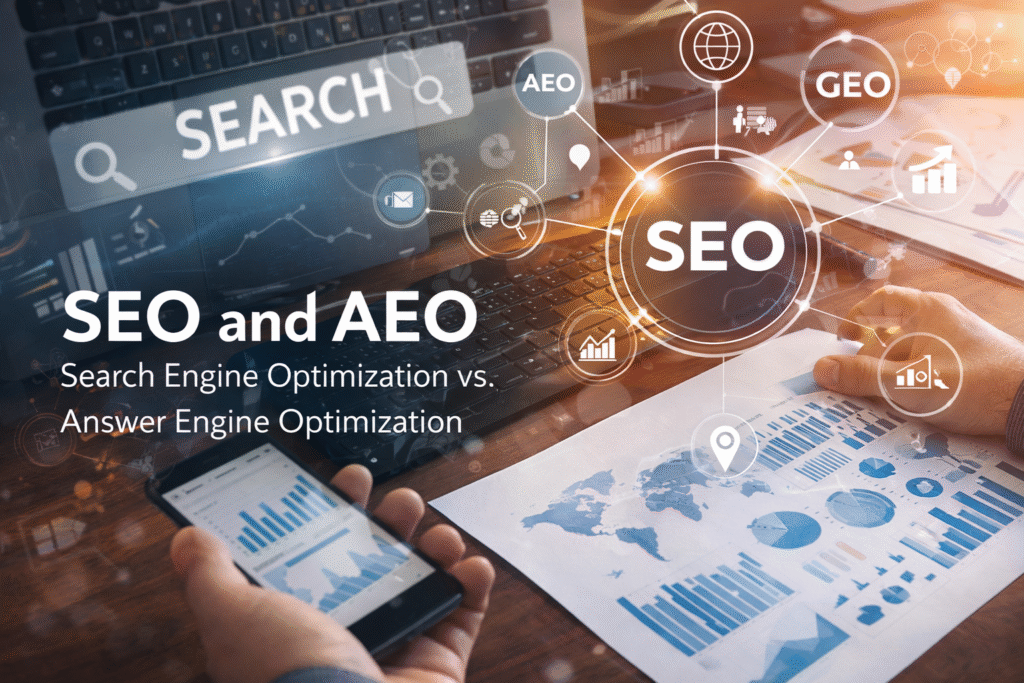
Direct answer: SEO helps pages rank, AEO helps pages get selected as direct answers, and GEO helps content get reused in generated responses.
Here are simple definitions:
- SEO (Search Engine Optimization): Improves visibility in search results using helpful content, keyword intent, internal links, backlinks, and technical site health.
- AEO (Answer Engine Optimization): Improves content so it can appear as a direct answer for question-based searches.
- GEO (Generative Engine Optimization): Improves content so it is easy to extract, trust, and reuse in generated summaries.
What stays important in all three methods?
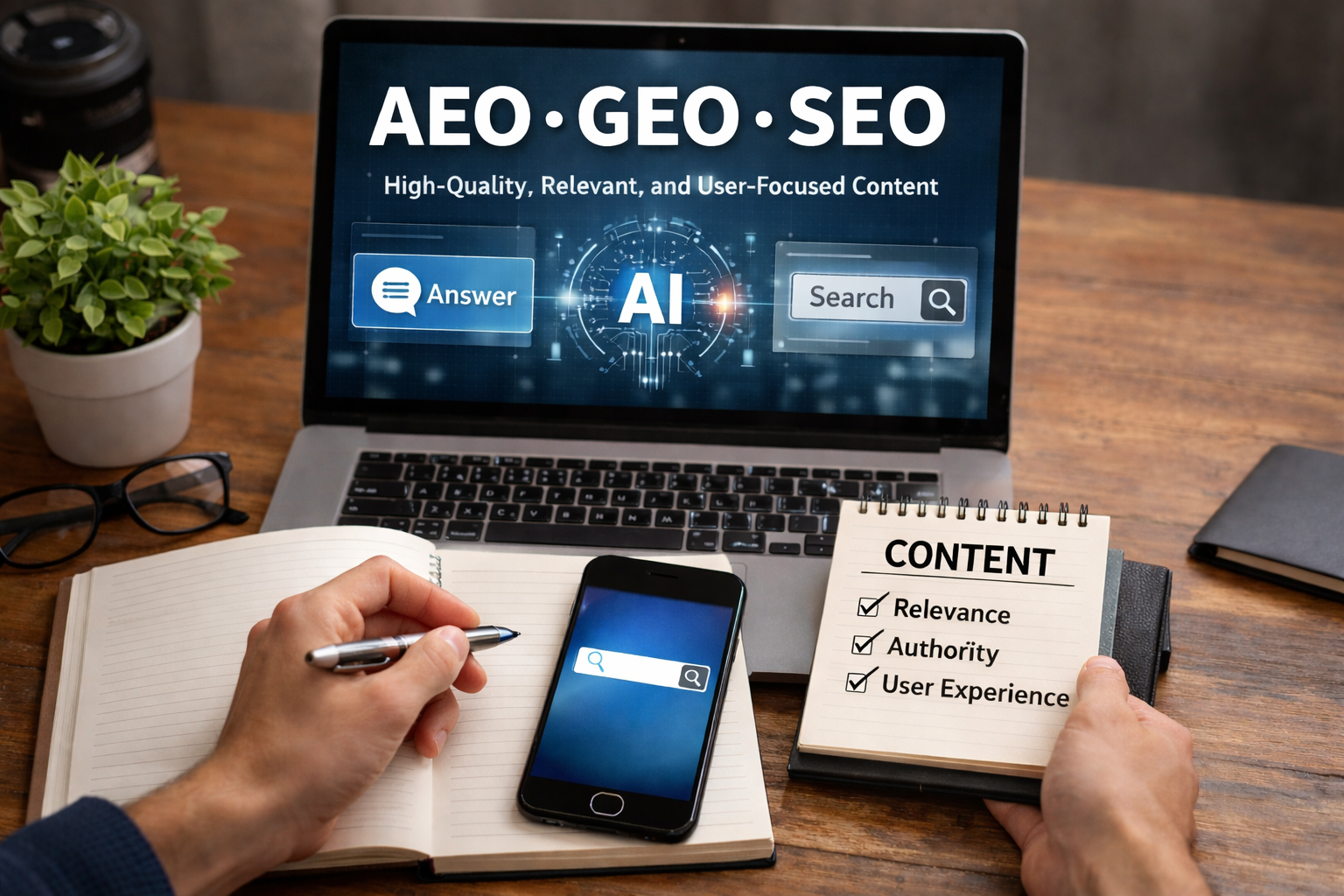
Even with new formats, the basics still matter. Strong pages usually have: one thing always remains essential: high-quality, relevant, and user-focused content. No matter the platform or algorithm, success depends on delivering clear information, strong intent matching, credibility, and a great user experience.
- one clear topic per page
- headings that match real user intent
- short paragraphs and simple wording
- fast loading and mobile-friendly layout
- trust signals (author name, brand, contact details)
If these basics are weak, it becomes harder to earn answer placements and summary reuse.
How should beginners think about the three methods?
Use this simple view:
- SEO = “Help people find my page”
- AEO = “Help people get the answer fast.”
- GEO = “Help systems reuse my clear information in summaries.”
Why is search moving from links to direct answers?
Direct answer: Users want faster help, so results pages show more answers directly.
Many searches are now full questions, for example:
- “What does this mean?”
- “How do I do it step by step?”
- “Which option is best for my case?”
- “How much does it cost?”
- “How long will it take?”
Because of this, results often include:
- featured snippets
- “People also ask” boxes
- short summaries above standard listings
- voice-style answers
What does this change for content planning?
It means your best answer must be easy to find. If the main point is buried in long text, it may not get selected.
A helpful page often includes:
- a clear promise near the top (what problem it solves)
- direct answers under question headings
- steps, checklists, and quick examples
- a short summary section
- FAQs that cover follow-up questions
How do you upgrade a page from SEO-only to AEO-ready?
Direct answer: Start each section with a short answer, then support it with steps, bullets, and simple examples.
AEO rewards clarity and structure. You do not always need more words. You need cleaner answers and a page that is easy to scan.
Step-by-step AEO upgrade checklist
- Pick one main intent for the page
Example: “how to improve local visibility” or “how to write a service page.” - Turn headings into real questions
Good heading styles include: - Add a direct answer under every main heading
Keep it 1–2 lines. Make it complete and clear. - Add one short example where it helps
Example: a short template, a sample checklist, or a quick “before and after” rewrite. - Finish with a mini summary and FAQs
This improves coverage for related questions.
What does a strong “Direct answer” block look like?
Use this repeatable pattern:
- Question heading
- Direct answer (1–2 lines)
- Short explanation (3–4 lines)
- Steps or bullets
- One common mistake to avoid
This format helps readers understand your content fast. It also makes it easier for answer features to pick your text.
Common AEO mistakes to avoid
- long intros before the first useful answer
- headings that sound clever but do not match real searches
- mixing too many topics in one section
- repeating the same point using new words
- giving advice with no steps or proof
How do you make content GEO-friendly for generated results?
Direct answer: Write content in clean, self-contained blocks with clear facts, definitions, and correct step order.
Generated summaries prefer content that is easy to reuse without losing meaning. Your goal is to publish information that can stand alone.
What GEO-friendly content includes
Strong GEO content often includes:
- Clear definitions: explain key terms in simple words
- Specific details: numbers, limits, tools, time ranges, or conditions
- Exact steps: actions in the correct order
- Context: who it is for and when it applies
- Trust signals: author info, organization info, and clear contact details
How do you make each section easy to reuse?
For each important section, include:
- a one-line answer or definition
- 3–6 bullets that support the answer
- one short “when this may fail” note
- one short “best practice” note
This creates small, complete blocks. These blocks are easier to extract and reuse in summaries.
What page basics support GEO?
Keep these strong:
- clear H2 and H3 heading order
- short paragraphs (2–4 lines)
- internal links to related pages on your site
- updated facts when tools or rules change
- one clear topic, with no topic drifting
How can learners and businesses in Jaipur build these skills?
Direct answer: Learn SEO basics first, add answer-first writing methods, then practice on real pages with tracking.
These skills can support roles in:
- SEO and content writing
- content strategy
- local business marketing
- analytics and reporting
- website content management
They can also help businesses improve:
- calls and leads
- trust and brand searches
- visibility for question-based queries
What should practical training include?
A useful training plan should cover:
- keyword research with intent grouping
- content planning using question maps
- on-page SEO (titles, headings, internal links)
- writing direct answers and FAQ sections
- basic technical checks (indexing, speed, mobile)
- reporting and improvement routines
Navigo Academy is one option some learners consider while comparing training choices.
A simple 14-day practice plan (beginner-friendly)
- Days 1–3: Pick one topic and list 15 real questions users ask
- Days 4–7: Write one guide page with question headings and direct answers
- Days 8–10: Add steps, examples, and an FAQ section
- Days 11–14: Improve readability, add internal links, and review performance
This builds skill through action and steady improvement.
What metrics should you track for SEO, AEO, and GEO?
Direct answer: Track rankings and traffic, and also track answer visibility and real business results.
Do not depend on one number. Use a small set of signals that match your goal.
SEO metrics (core)
- organic clicks and impressions
- ranking movement for target queries
- index coverage and crawl errors
- page speed and mobile usability
- internal linking coverage (important pages supported by other pages)
AEO metrics (answer visibility)
- featured snippet appearances
- “People also ask” visibility
- impressions for question-based queries
- click-through rate changes after content updates
GEO signals (practical indicators)
Direct GEO reporting can be limited, but you can still watch:
- growth in branded searches
- better engagement on guides (time on page, scroll depth)
- more referrals from discovery sources
- more mentions or references from other sites
A simple monthly improvement routine
- refresh the top 5 pages that already get impressions
- add 3–5 new questions based on real queries
- tighten weak sections with direct answers and steps
- remove fluff and repeated lines
- expand FAQs using real user follow-ups
Small improvements each month can bring stable growth over time.
Key Takeaways
- SEO brings visibility, AEO helps win direct answers, and GEO supports reuse in generated summaries.
- Put a Direct answer under each main question heading.
- Use short paragraphs, clear headings, and lists to improve scanning.
- Make sections self-contained with definitions, steps, and specific details.
- Track more than rankings: answer visibility and conversions matter.
Conclusion
SEO still matters, but modern search needs more than rankings. AEO helps your pages become strong direct answers through clear structure and question-focused writing. GEO helps your content become easier to extract and reuse by keeping sections factual, clean, and self-contained. If you plan to join a digital marketing institute in jaipur, ask if the training includes SEO plus answer-first writing and summary-ready content methods.
FAQs
1. Can one page be optimized for SEO, AEO, and GEO at the same time?
Yes. Use strong SEO basics, add direct answers for AEO, and keep sections self-contained for GEO.
2. What is the fastest AEO improvement I can make?
Add a Direct answer (1–2 lines) under every major question heading.
3. What content types earn answer placements most often?
Definitions, how-to guides, checklists, comparisons, and FAQ sections.
4. Do I need a special code to win the answer results?
Not always. Clear structure, clean headings, and direct answers can be enough.
5. How do I know if my page is GEO-friendly?
If each section can stand alone with a direct answer, supporting bullets, and clear steps, it is usually GEO-friendly.
6. How long does it take to see results after updates?
Many sites see early movement in a few weeks, but timing depends on competition, site health, and content quality.