Have you ever looked at a website and wondered how it works? The buttons you click, the forms you fill, the pages that load instantly – all of this magic happens because of developers. But not all developers do the same job. Some work on the parts you see, some work on the parts you don’t, and some brave folks do it all. If you’re thinking about a career in building websites and apps, you’ve probably heard the terms frontend, backend, and full stack. It’s easy to feel stuck trying to pick one path. Let’s break it all down in simple words, so you can make a choice that fits you perfectly.
What is Frontend Development?
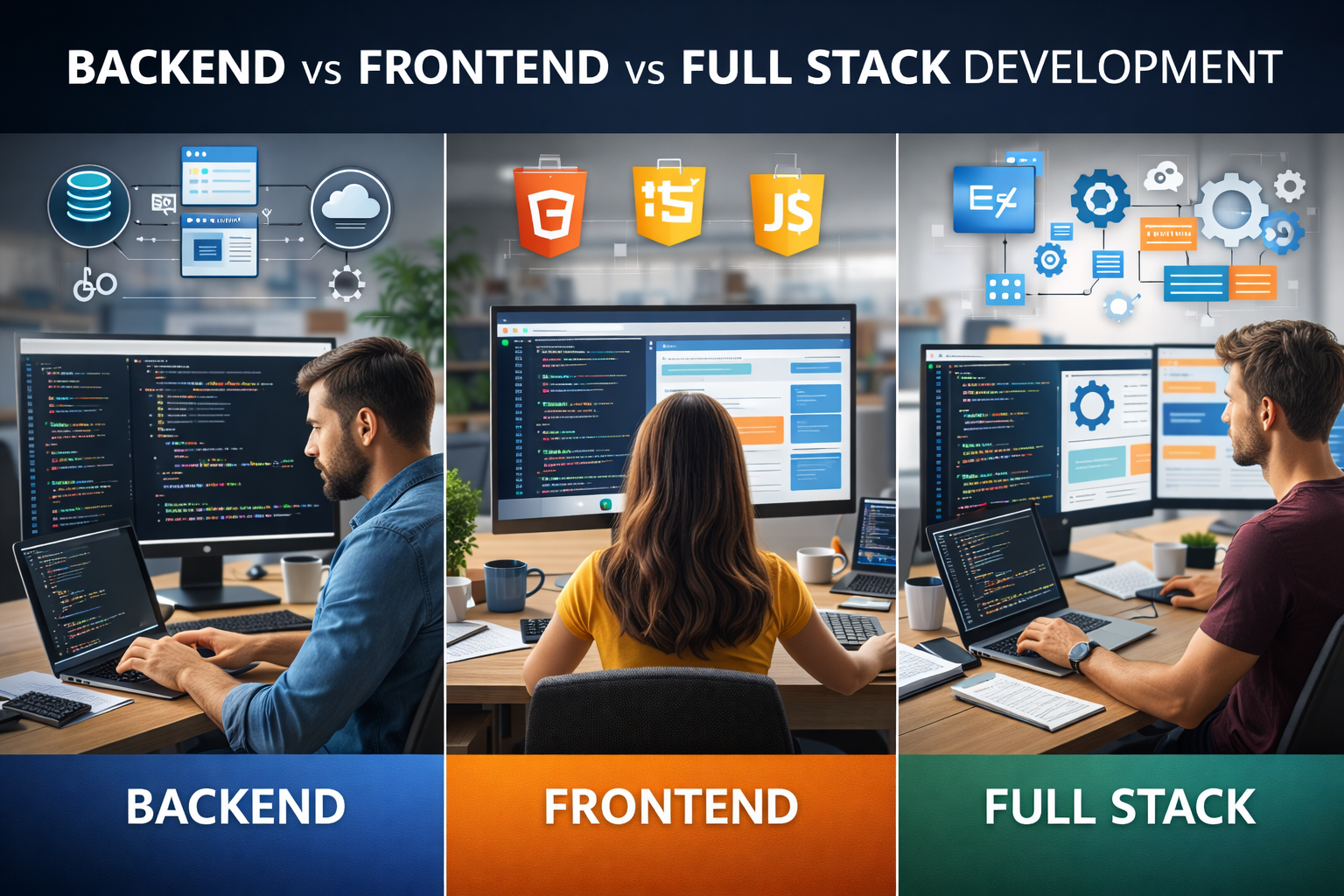
Think of a restaurant. The front end is everything you experience as a customer. The comfortable seating, the clean menu, the friendly waiter taking your order – that’s the frontend of a website. It’s the part you interact with directly.
A frontend developer uses languages like HTML, CSS, and JavaScript to build this visual experience. They make sure a site looks great on your phone, your tablet, and your computer. They create the animations, design the layouts, and ensure every click does what you expect.
What you’ll do as a frontend developer:
- Turn design ideas into working web pages.
- Make sure websites are fast and easy to use.
- Solve puzzles related to how things look on different screens.
- Work closely with designers to create a beautiful product.
If you enjoy visual creativity, pay attention to small design details, and love seeing your work come to life instantly in a browser, Frontend development could be your calling.
What is Backend Development?
Now, back to that restaurant. After the waiter takes your order, they go to the kitchen. This kitchen is hidden from customers. Chefs prepare the food, manage supplies, and coordinate orders. This kitchen is the back end. It’s the engine room that makes everything possible, even though you never see it.
Backend development is all about the server, the database, and the application logic. When you log into a website, the backend checks your password. When you search for a product, the backend finds it in a massive database. When you save a file, the backend stores it safely.
What you’ll do as a backend developer:
- Build and manage the logic that powers applications.
- Work with databases to store and organize information.
- Keep data safe and secure from unauthorized access.
- Make sure servers can handle many users at once without crashing.
If you love solving logical problems, working with data, and building strong, invisible systems that hold everything together, you might be a natural backend developer.
The Full Stack Developer: The Best of Both Worlds
A full stack developer is someone who can handle both the frontend and the backend. Imagine a restaurant owner who can both design a beautiful dining room and run an efficient kitchen. They understand the entire flow of the business.
This doesn’t mean they are experts in every single technology. It means they have a working knowledge of all the layers involved in creating a web application. They can build a feature from start to finish – from how it looks to how it saves data.
Why choose the full stack path?
- Versatility: You can work on any part of a project, making you very adaptable.
- Better Communication: You understand what both frontend and backend teams need, which helps projects run smoother.
- Great for Startups: Small companies often need one person who can do many things.
- Broader Perspective: You see the big picture of how an application is built.
It’s a challenging path because there’s more to learn, but it can be very rewarding for those who enjoy variety and understanding how everything connects.

How to Choose Your Path
Still unsure? Ask yourself these questions:
- What do you enjoy more: looks or logic?
Do you get excited about beautiful layouts, smooth animations, and perfect colors? Or do you prefer solving puzzles, organizing data, and building efficient systems? Your answer points you to frontend or backend. - Do you like to see results immediately?
Frontend work gives you instant visual feedback. Change a color in your code, and you see it right away. Backend work often involves more testing to see if your logic works correctly. Which feedback loop feels better to you? - Do you want to specialize or generalize?
Being a specialist in frontend or backend can make you a top expert in a specific area. Being a generalist as a full stack developer makes you flexible and valuable in different ways. Think about your long-term career style. - What’s the job market like near you?
Look at local job listings. For instance, if you’re in Jaipur, search for opportunities in each area. You might find a great demand for a specific skill that helps you decide. Taking a respected full stack developer course in Jaipur could be a smart way to launch a versatile local career.
Getting Started on Your Journey
No matter which path you choose, the first steps are similar. Start with the basics of HTML and CSS. Then, learn JavaScript. This foundation is useful for all three paths.
- For Frontend: After JavaScript, dive into a framework like React. Practice by cloning the look of websites you admire.
- For Backend: Choose a server-side language like Python or Node.js. Learn about databases like MySQL or MongoDB. Try building a simple application that saves user data.
- For Full Stack: You’ll need to learn both frontend and backend skills. A structured program, like a comprehensive course, can guide you through this broader curriculum efficiently.
Remember, your first choice isn’t permanent. Many developers start in one area and then move to another as their interests change. The most important thing is to start building things. Create small projects. Break them. Fix them. This hands-on experience will teach you more than anything else and show you what you truly enjoy.
Conclusion
There is no single “best” choice between frontend, backend, and full stack development. The best path is the one that matches your brain and your interests. The world needs talented specialists who create stunning user interfaces. It needs brilliant architects who build robust systems. And it needs versatile developers who can bridge the gap between the two. Understand what each role involves, be honest about what excites you, and take that first step. A rewarding career in building the digital world is waiting for you, no matter which door you choose to walk through first.
Frequently Asked Questions (FAQs)
-
Which pays more: frontend, backend, or full stack?
Salaries can vary based on experience, location, and company. Often, specialized senior backend roles and experienced full stack roles can command very high salaries. However, excellent developers in any area are well-paid. Focus on becoming skilled in your chosen path.
-
Is full stack development too hard for a beginner?
It can be overwhelming to learn everything at once. Many people recommend starting with either frontend or backend first. Once you’re comfortable with one side, learning the other becomes easier. Then, you can combine your knowledge to become full stack.
-
Do I need a computer science degree?
While a degree is helpful, it is not strictly necessary. The tech industry values skills and a strong portfolio. Many successful developers are self-taught or have completed focused training programs and bootcamps.
-
How long does it take to become job-ready?
For frontend or backend, with dedicated daily study, you could build a basic portfolio in 6-8 months. For full stack, it might take 10-12 months to feel comfortable with both sides. Consistency is more important than speed.
-
Can I switch from frontend to backend later?
Absolutely! Your initial experience will be a great advantage. You already understand how web applications work from one angle. Learning a second skill set is often easier than learning the first.