Every app you use has a backend doing the real work. When you log in, place an order or make a payment, a server checks your data, talks to a database and sends back a response. Backend developers build that hidden layer.
If you are a student, fresher or career switcher in Rajasthan’s capital, Backend Development Training Jaipur is a practical way to enter the IT industry. This guide covers the skills you learn, the tools you use and how to pick the right programme.
What Is Backend Development?
Backend development is the server-side part of a website or application. It covers:
- Business logic and application rules
- Databases and data storage
- APIs that connect the frontend, mobile apps and third-party services
- Authentication, security and performance
Frontend developers build what users see. Backend developers build what makes it work.
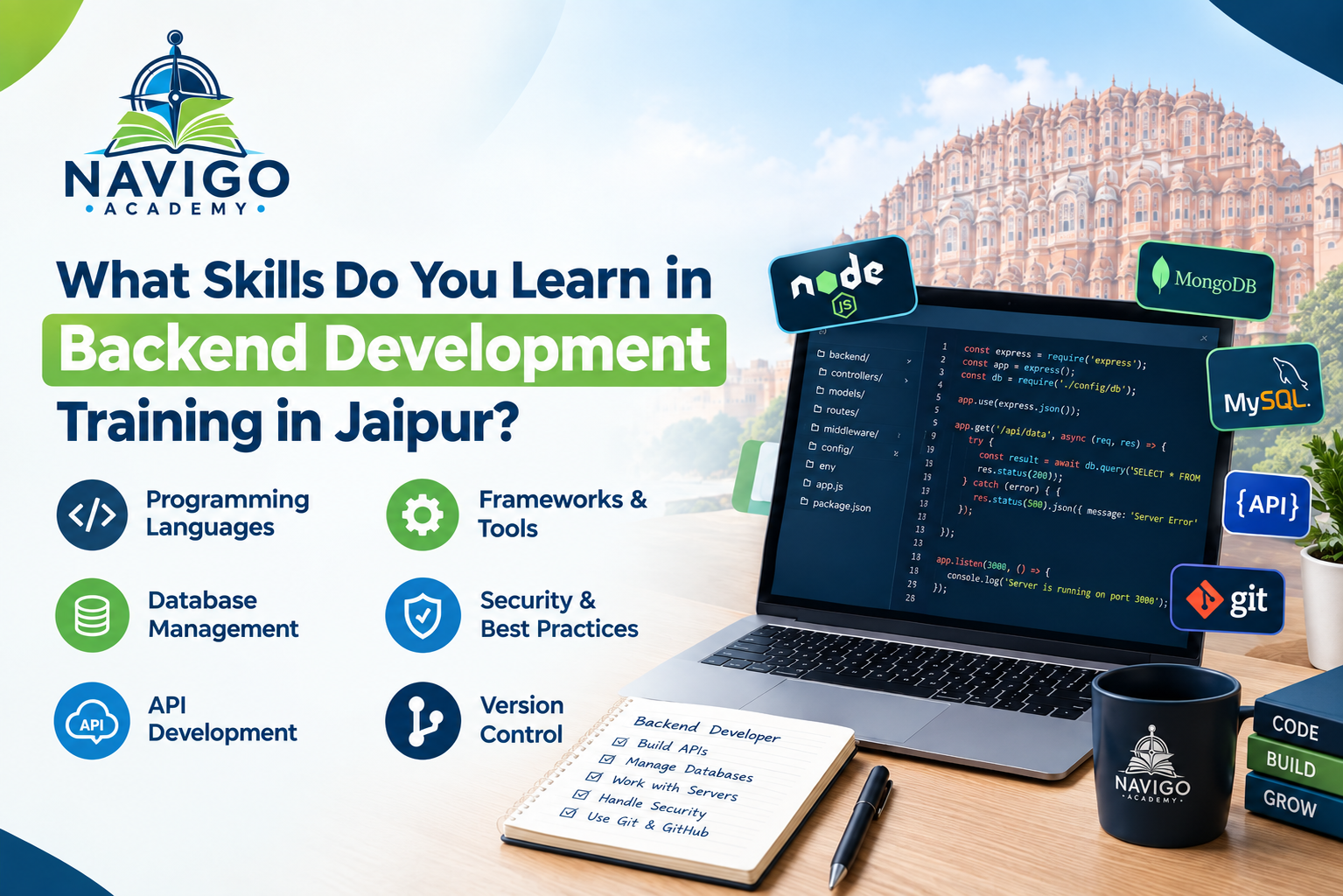
Core Skills You Learn in Backend Development Training
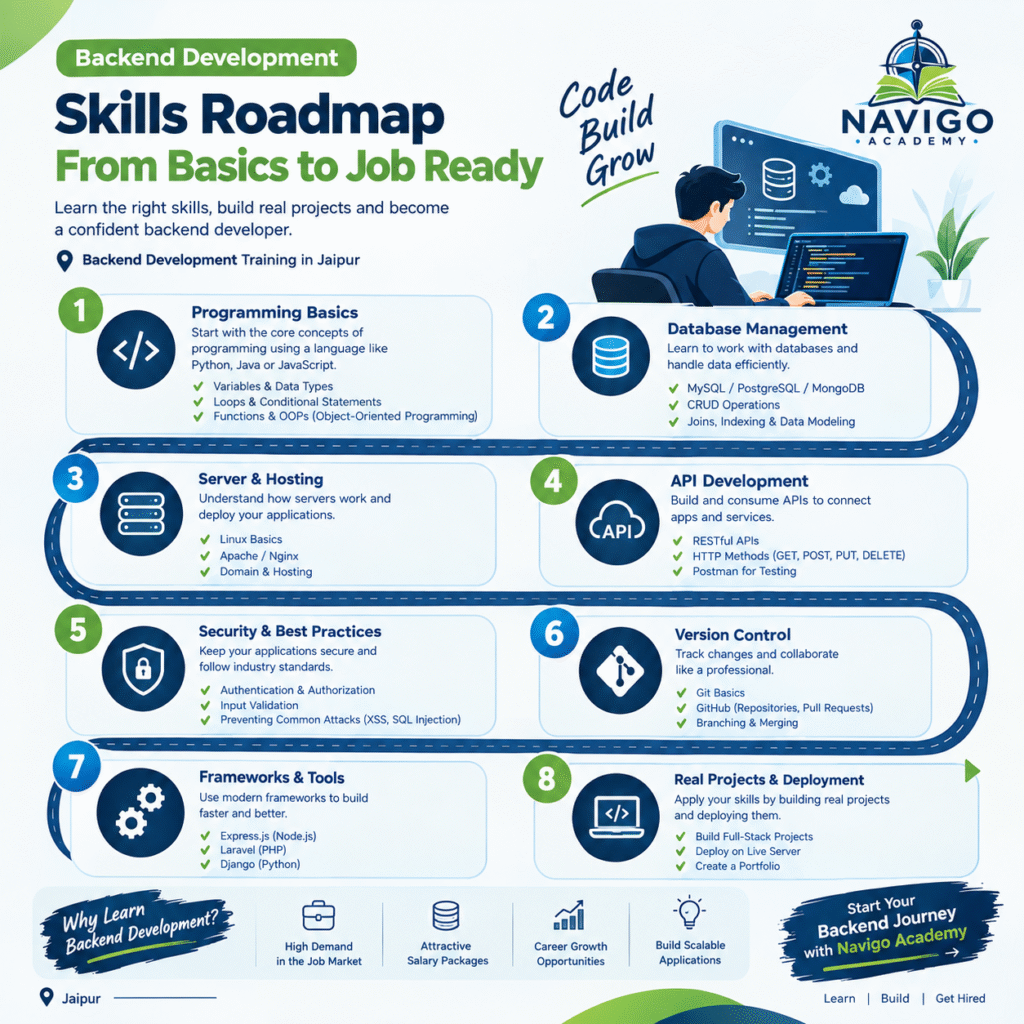
A good Backend Development Training Jaipur program moves from fundamentals to real projects. Here is what to expect.
1. A Backend Programming Language
You start with one server-side language and learn it deeply. Common choices are:
- Node.js (JavaScript): popular for fast, scalable web apps
- Python: beginner-friendly, used with Django and Flask
- Java: common in enterprise and banking software
- PHP: widely used for websites and CMS platforms
You learn variables, functions, loops, object-orientated programming, error handling and asynchronous code.
2. Databases and Data Modelling
Almost every backend app stores data, so database skills matter a great deal.
- SQL databases: MySQL and PostgreSQL, including joins, indexes and normalization
- NoSQL databases: MongoDB for flexible, document-based data
- Data modeling: designing tables and relationships that scale
- ORMs: tools like Sequelize, Mongoose or Django ORM
3. API Development
APIs let different software systems talk to each other. You learn to:
- Build REST APIs with proper routes and status codes
- Handle requests, responses and validation
- Use JSON for data exchange
- Test endpoints with Postman
- Get an introduction to GraphQL
4. Frameworks and Server Logic
Frameworks speed up development and keep code organized. Typical choices are Express.js, Django, Spring Boot and Laravel. You learn routing, middleware, MVC architecture and project structure.
5. Authentication and Security
Security is a must-have skill, not an extra. Training usually covers:
- User registration and login
- JWT and session-based authentication
- Password hashing
- Role-based access control
- Protection against common threats such as SQL injection and cross-site scripting (XSS)
6. Version Control and Collaboration
You learn Git and GitHub to track changes, work in branches, resolve merge conflicts and collaborate on team projects.
7. Deployment, Cloud and DevOps Basics
Writing code is only half the job. You also learn to:
- Deploy apps on cloud platforms such as AWS or similar services
- Work with Linux commands
- Manage environment variables
- Use Docker basics
- Understand CI/CD concepts
Skills at a Glance
| Skill Area | Tools You May Learn | What You Can Build |
|---|---|---|
| Programming | Node.js, Python, Java, PHP | Server logic, automation scripts |
| Databases | MySQL, PostgreSQL, MongoDB | Data-driven applications |
| APIs | Express, Django REST, Postman | Backends for web and mobile apps |
| Security | JWT, bcrypt, OAuth basics | Secure login systems |
| Version Control | Git, GitHub | Team-ready project history |
| Deployment | Linux, Docker, cloud basics | Live, hosted applications |
Soft and Professional Skills You Also Build
Technical skills get you interviews. These skills help you keep the job:
- Problem-solving: breaking large problems into small, testable steps
- Debugging: reading logs and tracing errors
- Documentation: writing clear API docs and README files
- Teamwork: working in sprints and code reviews
- Interview readiness: data structures, algorithms and system design basics
Projects You Should Build During Training
Employers hire on proof. Look for training that includes projects like these:
- A user authentication system with login and signup
- An e-commerce backend with products, carts and orders
- A blog or CMS API with admin controls
- A payment-integrated booking application
- A deployed capstone project with a live link
Put these on GitHub and in your resume.
Career Opportunities After Backend Development Training
After completing backend development training in Jaipur, you can apply for roles such as:
- Backend Developer
- Node.js or Python Developer
- API Developer
- Junior Software Engineer
- Full Stack Developer, after adding frontend skills
Jaipur’s IT sector includes software companies, startups and service firms, and many hire freshers who show strong project work. Salaries vary by company, skill level and city, so check current listings on job portals instead of relying on fixed numbers.
How to Choose the Right Training Institute
Not every course delivers the same results. Check these points before you enroll:
- Updated curriculum: it should include current tools, not outdated syllabi
- Hands-on training: you should write code daily, not just watch lectures
- Experienced trainers: ideally people with real industry experience
- Live projects: a portfolio matters more than a certificate
- Placement support: resume help, mock interviews and company connections
- Small batches: more individual attention and doubt clearing
- Location and timing: easy access and flexible batches
If you want the best IT training institute in Mansarovar, Jaipur, visit the campus, attend a demo class and ask to see past student projects. Navigo Academy is one option to evaluate against these criteria.
Is Backend Development Right for You?
Backend development suits you if you:
- Enjoy logic and problem-solving
- Like working with data and systems
- Are patients with debugging
- Want a career with strong long-term demand
You do not need a computer science degree to start. A willingness to practice every day matters more.
Conclusion
Backend development combines programming, databases, APIs, security and deployment into one high-demand skill set. The right training gives you tools, projects and the confidence to work on production-level applications.
If you are ready to start, explore Backend Development Training Jaipur options, compare institutes and book a demo class. Begin with one language, build real projects and keep practicing consistently.
Frequently Asked Questions
1. What is taught in Backend Development Training Jaipur?
You learn a server-side language, databases, API development, authentication, Git and deployment. Good programs also include live projects and interview preparation.
2. Can a beginner join backend development training?
Yes. Most programmes start from programming basics, so no prior coding experience is required.
3. Which backend language should I learn first?
Node.js and Python are popular beginner choices. Pick one based on your career goals and the jobs you want to target.
4. How long does backend development training take?
Most programmes run from three to six months, depending on depth, batch pace and whether they include full-stack content.
5. Do I need a degree to become a backend developer?
No. Many companies value skills and projects over formal degrees, though some roles may list a degree as preferred.
6. What is the difference between frontend and backend development?
The frontend is what users see and interact with. Backend is the server, database and logic behind it.