
The majority of people think of the web and UX/UI design as being the identical things. They’re not. If you choose the wrong route, it will cost you many months of time and money. This blog explains both of these fields in detail and explains what they mean and what they are different about and which one pays the highest and which one is the best to be studying based on the goals you have. At the end of this blog you’ll know exactly where to begin.
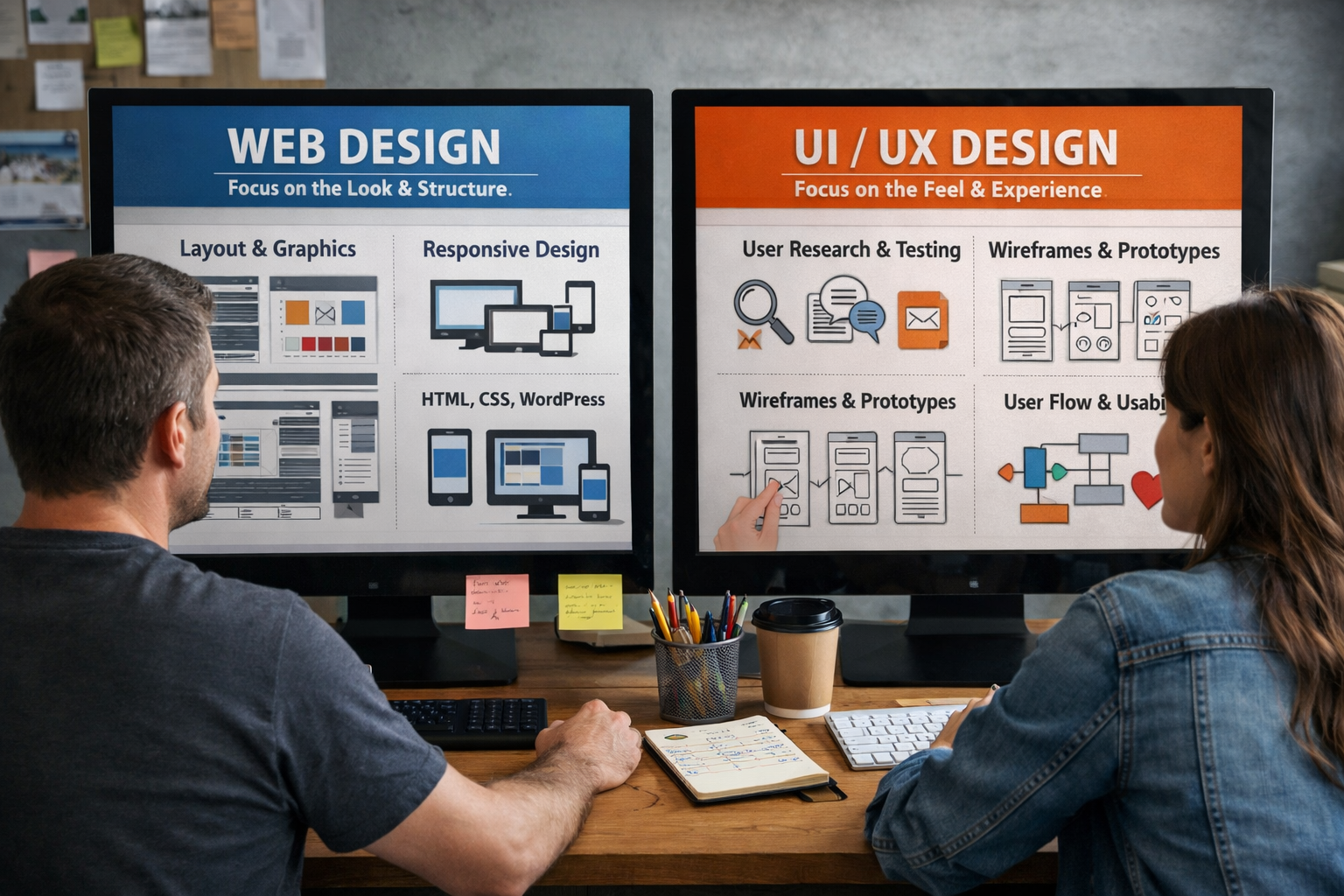
Web design is focused on designing the visual appearance of websites, including layouts and colors, fonts, and pictures. The concept of UI/UX design extends beyond that. It encompasses the entire experience the user gets from applications, websites as well as digital products. Web design is a part of UX/UI. UX is a combination of user research, interaction design and usability tests over visual design.
What is Web Design?
Designing a website is preparing and constructing the visual structure of websites. When a user visits a website and sees everything they see the layout and images, colors, buttons and fonts is a outcome of the web’s design. Web designers decide what a website’s look and the way visitors navigate through it. The aim is to create websites that are visually appealing and user-friendly.
Web designers usually use:
- Use Figma and Adobe XD for visual mockups
- WordPress or Webflow for creating pages
- CSS and HTML for the the basic structure of front-ends
- Photoshop is a tool for editing images
Web design is a fundamental responsibility for a designer are:
- The design of the homepage and internal layouts of pages
- Selecting fonts, colors spacing, colors, and other visual elements
- Making websites compatible with both desktop and mobile devices.
- Making page mockups and wireframes
What is UI/UX Design?
Designing UI/UX refers to the method of creating the entire experience a person is able to enjoy with any digital item. It is a field that has two components. UI (User Interface) is the way things appearicons, buttons as well as colors and screens. UX (User Experience) is all about how things function — how simple and straightforward it is for users to finish the task. UI without UX creates stunning but complicated products. UX without UI produces functional, but boring designs. Good products require both.
UI/UX design applies to:
- Mobile apps
- Web-based applications as well as SaaS platforms
- E-commerce stores
- Software for fintech and banking
- Education and health platforms
The most important responsibilities for a UI/UX designer are:
- Conducting user research, interviews and interviews
- The creation of user personas and journey maps
- Making wireframes and interactive prototypes
- Usability tests are conducted with real users
- Designing new designs based on feedback and data
A ui ux course in jaipur provides hands-on training in all these areas through real-world projects, mentorship, as well as guideline for portfolios that self-learning typically can provide.
What is the Real Difference Between Web Design and UI/UX Design?
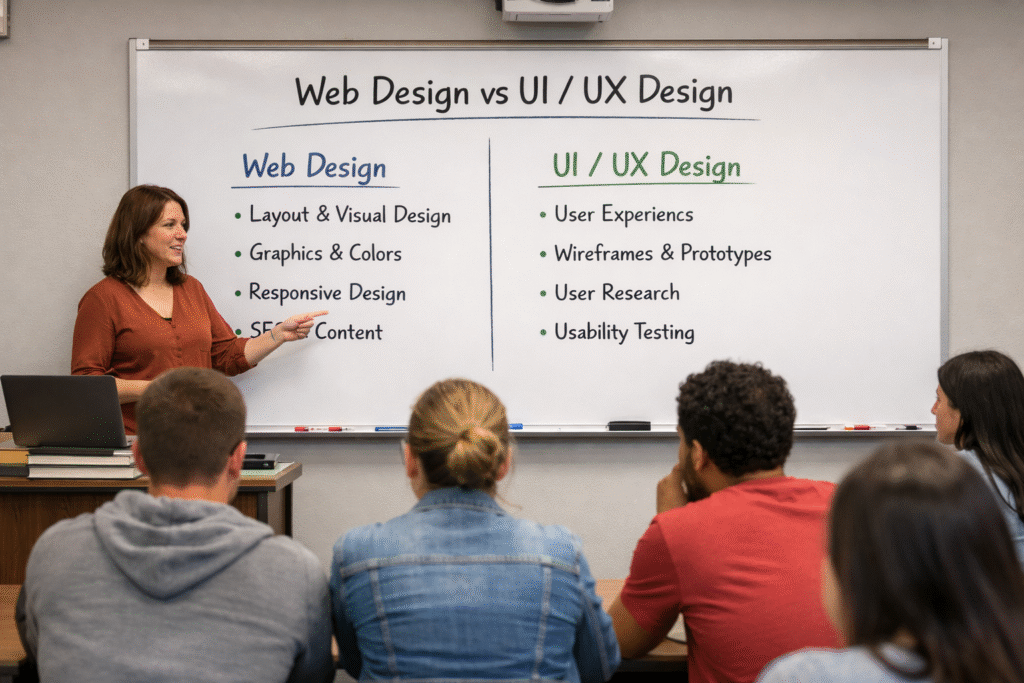
The primary difference is the its scope. Web design covers websites. UX/UI design is concerned with the entire digital experience and is much more extensive. Here’s an easy method of thinking about it:
Side-by-Side Comparison Table
| Feature | Web Design | UI/UX Design |
| Focus Area | Website images | Complete user experience |
| Scope | Websites are only available for viewing. | Apps, software, websites, dashboards |
| User Research | Rarely are they included | The most important part of the process |
| Key Tools | Figma, WordPress, HTML/CSS | Figma, Maze, Miro, Adobe XD, Hotjar |
| Testing | Tests of devices and browsers | Testing usability A/B testing |
| Main Deliverables | Page layouts Mockups, page layouts | Personas, user flows, prototypes |
| Creativity Level | High Visual Creativity | Innovative and analytical thinking |
| Salary (India) | Rs2.5 – 5 LPA | Rs4 – 20+ LPA |
| Career Growth | Stable | Demand is high, and fast-growing. |
| Learning Path | Beginner-friendly | Intermediate, requires structure |
Both roles are important. But UI/UX opens more doors across more industries. ansferring designs to developers for programming
The process of designing websites is a good starting point for those who are only beginning their journey. It is crucial to follow an organized course in web design.The course covers layout concepts and responsive design, as well as other important tools in one place.
Where Do Web Design and UI/UX Design Overlap?
Both fields have a solid basis in the visual design process, prototyping and user-centered thinking.
If you are already familiar with web design, the transition to UX and UI is natural. You know layouts and graphics. Training in UI/UX is just adding research and strategy as well as testing over the knowledge you already have.
The skills shared by the two fields:
- Layout principles and visual hierarchy
- Typography and color theory
- Mobile-first and responsive design
- Wireframing and mockup design
- Afigma, and Adobe XD proficiency
- A basic understanding of the front-end structure
The strongest overlap occurs within it’s UI (User Interface) part of UI/UX. This is the work that web designers perform every day. The distinction is that UI/UX designers look deeper and think about the reasons before designing something.
Step-by-Step Learning Path: From Beginner to Hired Designer
You can follow this course if you’re looking to become web designers, UI designer or UX designer.
Step 1 – Learn Design Basics Begin with typography, color theory visual hierarchy, the principles of layout. These are applicable to any design position.
Step 2 — Take a Web Design Course
A web design course that is structured will teach you Figma as well as the responsive web design WordPress as well as basic HTML/CSS. Create 3-5 real-world website projects in this phase.
Step 3 — Learn UX Principles
Learn about methods to research users such as empathy mapping, user personas and mapping the customer journey. This is where design becomes strategic.
Step 4 — Master Prototyping Tools
Learn Figma thoroughly — its components that include Auto layout, Interactive Prototypes as well as design and layout systems. Also, you can explore Adobe XD and Maze for testing.
Step 5 — Run Usability Tests
Make your prototypes testable with real people. Examine the areas how they react. Redesign your plans according to what you observe.
Step 6 — Build a Strong Portfolio
Include 3-5 case studies. Every case study must demonstrate the process you followed — wireframes, research, final design, and the results. Portfolios are more important than certificates.
Step 7 — Apply and Get Feedback
Apply for junior positions. Participate in design events. Get portfolio reviews. Iterate quickly. The majority of designers get their first job in 6-9 months of continuous learning.
If you live located in Rajasthan taking an ui ux class in jaipur offers you a structured mentorship along with live projects and assistance with placementAll of which can speed up this timeframe significantly.
Real Example: Priya’s Journey from Web Designer to UI/UX Designer
Khusi was an art and design graduate from Jaipur. She graduated in 2022. began working as a freelance web designer, creating WordPress sites for the local restaurants as well as retail stores. Her work looked great. However, clients were always wanting mobile-friendly designs, better navigation flow and more nimble experience. She didn’t have these capabilities yet.
She enrolled in a formal UX/UI course in Jaipur. In the course of six months she learned the art of wireframing, user research, interactive prototyping, as well as testing usability. She revamped a local food delivery application as her capstone assignment — in reducing the number of checkout steps from seven to three based upon the feedback of users. The result? She was offered a full-time UI/UX position at a Jaipur-based startup for Rs5.2 LPA — an increase from Rs1.8 LPA while working as a web designer on a contract basis.
Her background in web design provided her with strong visual skills. The UX/UI training taught her the process and strategy. Together they created her unstoppable.
Which Career Path Pays More?
UX/UI designers get paid significantly more, particularly at the mid and upper levels.
Here’s a realistic salary breakdown for India:
| Role | Jr. (0-2 years) | Mid-Level (2-5 years) | Senior (5plus years) |
| Web Designer | Rs2.5 – 4.5 LPA | Rs4.5 – 7 LPA | Rs7 – 12 LPA |
| UI Designer | Rs3.5 – 6 LPA | Rs6 – 10 LPA | Rs10 – 18 LPA |
| UX Designer | Rs4 – 7 LPA | Rs7 – 14 LPA | Rs14 – 25+ LPA |
Freelance designers for UI/UX have higher rates for projects -due to the fact that they provide research strategy, testing, and strategy — not only visual documents.
Common Mistakes Beginners Make
Beware of these mistakes and you will save hours of effort.
- The two fields are treated as if they were identical, they are not — but they serve different purposes.
- Not doing enough user research design without understanding your customers is a recipe for disaster.
- Overanalyzing tools Figma is only tool. Design thinking is the real talent
- A portfolio that is not built just a few certificates won’t make you a candidate for employment.
- Inattention to mobile-first design more than 60% of traffic to websites originates from mobile devices
- Never test designs if users haven’t tried your design, it’s not done
- Copying trends and not understanding the fundamentals The trends are constantly changing but the principles don’t.
- The fear of giving up after rejection Designers typically have to endure 10-20 rejections before obtaining their first position.
Web design is primarily focused on the design and layout of web pages. The UI/UX design is the total experience of a digital product which includes research as well as interface design interactivity flows, and usability testing. Web design is a part of the UI/UX. The UI/UX approach goes beyond visuals and helps be able to understand the reasons why users behave in as they do.
Featured Snippet: Should I Learn Web Design or UI/UX Design First?
projects. Then, move on to UI/UXadding prototyping, user research, as well as usability tests. This will give you the ability to see and think strategically and makes you a skilled designer with more job prospects.
Featured Snippet: What Do UI/UX Designers Actually Do?
Key Takeaways
- Web design is about website visuals; UI/UX is about the full digital experience
- UI/UX design includes research, prototyping, and testing — not just layouts
- Web design is the best starting point for beginners
- UI/UX offers higher salaries and faster career growth
- A strong portfolio with case studies matters more than any certificate
- Structured learning with real projects gets you hired faster than self-study alone
Web design creates the visual appearance of websites. UI/UX design covers the complete user experience across all digital products. Web design is a subset of UI/UX. Learning web design first builds your visual foundation. Adding UI/UX skills opens higher-paying roles across apps, software, and product companies.
Conclusion
Web design and UI/UX design are not the same — and knowing the difference can change your entire career direction. Web design teaches you how to make things look good. UI/UX teaches you how to make things work well for real people. Both skills together make you a designer that every company wants to hire. Start with the basics. Build real projects. Test with real users. Put it all in a portfolio. The design industry is growing fast — and it needs people who can think clearly, design confidently, and solve real problems. Your next step is simple. Pick a structured course, commit to daily practice, and start building.
Frequently Asked Questions (FAQs)
- Is web design a part of UI/UX design?
Yes. Web design overlaps heavily with the UI (User Interface) part of UI/UX. However, UI/UX also includes user research, interaction design, and usability testing — which traditional web design does not cover.
- Can I get a job with only web design skills?
Yes. Many companies hire web designers for website projects, WordPress builds, and landing page design. However, adding UI/UX skills significantly increases your job options and earning potential. - Do UI/UX designers need to know how to code?
No. Coding is not required for UI/UX design. Understanding basic HTML and CSS is helpful for communicating with developers, but tools like Figma handle everything a UI/UX designer needs without code. - How long does it take to become a UI/UX designer?
With a structured program and consistent daily practice, most learners become job-ready in 4–6 months. Self-learning without guidance typically takes 10–14 months because of trial and error. - What is the best tool for UI/UX design in 2025?
Figma is the industry standard. It is used for wireframing, visual design, prototyping, and team collaboration. Most companies expect Figma proficiency when hiring UI/UX designers. - Which is better — web design or UI/UX design for freelancing?
Both work well for freelancing. Web designers get steady work from small businesses needing websites. UI/UX designers charge higher rates for app design, product strategy, and research projects. UI/UX freelancers generally earn more per project.