Best Institute for Web Development Course in Jaipur
Best Institute for Web Development Course in Jaipur
Web development is one of the most in-demand skills in the tech industry today. Every business needs a website, every startup needs a digital product, and every company needs developers who can build, maintain, and improve their online platforms. For students and professionals in Jaipur who want to enter this field, choosing the right training institute is the most important decision they will make.
But with so many options available across the city, how do you identify which institute actually delivers on its promises? This guide helps you understand what to look for in a web development institute, what separates great training from average courses, and how to make a choice that genuinely launches your career.
Why Web Development Is a Career Worth Pursuing
The demand for skilled web developers has grown steadily every year, and 2026 is no exception. Businesses across every industry, e-commerce, healthcare, education, finance, and entertainment, need developers who can build responsive, fast, and user-friendly websites and applications.
Web development offers competitive salaries even at the entry level. It provides the flexibility to freelance, the option to build your own products, and the ability to contribute to projects that millions of people use daily. Whether you are a fresh graduate looking for your first career or a professional wanting to switch fields, web development gives you skills that remain relevant and valuable for years to come.
What Makes a Web Development Institute Stand Out
Not every institute delivers the same quality of training. Some focus heavily on theory, others use outdated curricula, and many prioritize batch size over individual student growth. Here are the factors that separate a truly good institute from the rest:
A Curriculum That Covers What the Industry Needs
The tech industry moves fast. A web development course that was relevant two years ago may already be outdated in key areas. The best web development course in Jaipur should cover both frontend and backend technologies that employers are actively hiring for right now.
A strong curriculum includes:
- HTML, CSS, and JavaScript Fundamentals:
These are the building blocks of every website. A solid course starts here and ensures students understand structure, styling, and interactivity at a deep level before moving to advanced topics. Rushing through fundamentals creates gaps that haunt students throughout their careers. - Modern Frontend Frameworks (React, Angular, or Vue):
Employers expect developers to know at least one modern framework. React is the most in-demand choice globally. A good program teaches students how to build real applications using these frameworks, not just how to follow along with tutorials. - Backend Development (Node.js, Python, or PHP):
A complete web developer understands both the frontend and the backend. Server-side programming, database management, API development, and authentication systems are essential skills that make you a full-stack developer, the most versatile and employable profile in the market. - Database Management (MongoDB, MySQL):
Every web application stores and retrieves data. Understanding how databases function, how to design efficient data structures, and how to write queries is fundamental to building applications that perform well under real-world conditions. - Version Control (Git and GitHub):
Every professional development team uses Git for code management and collaboration. An institute that skips this topic leaves students unprepared for how real development teams operate on actual projects with multiple contributors. - Deployment and Hosting:
Knowing how to build an application is only half the skill. Deploying it to a live server, configuring domains, managing hosting environments, and understanding basic DevOps concepts complete the picture and make you truly job-ready.
Hands-On Project-Based Training
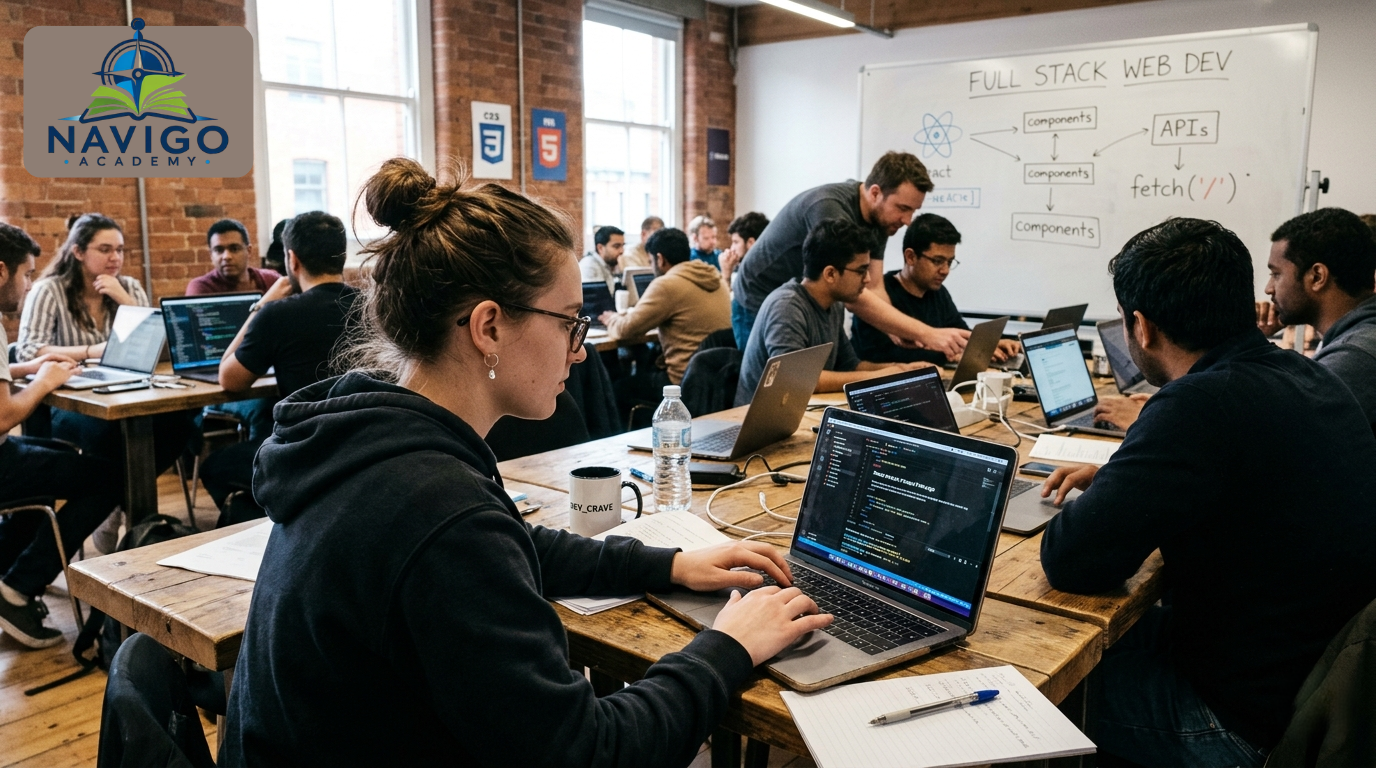
Reading about code and writing code are two completely different things. The best institutes prioritize hands-on practice over slides and lectures. Students should build real projects during the course, personal portfolio websites, e-commerce platforms, task management apps, and API-driven applications that they can showcase to employers.
Project-based training teaches problem-solving, debugging, and the practical challenges that arise in real development scenarios. These experiences build confidence and prepare students for the actual demands of a professional development role.
Experienced Faculty with Industry Background
The quality of your instructors directly affects the quality of your learning. Trainers who have built real products, solved real coding challenges, and delivered projects under real deadlines bring a depth of knowledge that purely academic teachers cannot offer.
Ask about the faculty’s professional background before enrolling. Have they built applications used by real users? Do they bring current industry practices and real case studies into the classroom? The answers to these questions reveal whether you will learn from someone who truly understands the field.
Small Batch Sizes for Personal Attention
Large batches mean less individual attention. In a class of 50 students, it is nearly impossible for the instructor to review each student’s code, address individual doubts, and provide personalized feedback on projects.
Smaller batches, ideally 15 to 25 students, create an environment where every student can ask questions freely, get their code reviewed individually, and receive guidance tailored to their specific learning pace and challenges.
Placement Support That Goes Beyond Promises
A certificate alone does not land you a job. The right institute helps you prepare for the job market through resume building, portfolio reviews, mock interviews, and direct connections with hiring companies. Some institutes also offer internship placements that give students professional experience before they start applying for full-time roles.
Be cautious of institutes that guarantee 100% placement without conditions. No institute can control hiring decisions. What a good institute can do is prepare you thoroughly and connect you with genuine opportunities.
Why Jaipur Is a Growing Hub for Web Development Training
Jaipur’s IT sector has expanded significantly over the past few years. The city now hosts a growing number of tech startups, IT service companies, and digital agencies that need skilled web developers. This local demand creates real job opportunities for graduates who train in the city.
The cost of training in Jaipur is also more affordable compared to metro cities such as Delhi, Mumbai, or Bangalore, without compromising on quality. Students get access to strong training programs, practical exposure, and placement opportunities at a fraction of the cost they would pay elsewhere.
Making the Right Choice
With multiple institutes competing for your attention in Jaipur, the decision can feel overwhelming. Here is how to cut through the noise:
Visit the institute in person and observe the learning environment. Ask to see the full syllabus and confirm it covers the technologies mentioned above. Speak with current students or recent graduates about their honest experience. Check the faculty credentials and their real-world development background. Understand the complete fee structure with no hidden charges. Ask specific questions about placement support and how the institute connects students with employers.
Navigo Academy has established itself as the best web development institute in Jaipur by delivering training that is built around real-world applications and current industry standards. With a project-based curriculum covering frontend, backend, and full-stack development, mentorship from experienced developers, small batch sizes for personalized attention, and dedicated placement assistance, the academy ensures every student graduates with the skills, portfolio, and confidence needed to succeed in the professional web development market.
Who Should Enroll in a Web Development Course
This training is designed for a wide range of learners:
- College Students and Fresh Graduates:
If you are about to enter the job market and want a high-demand skill set, web development training gives you a significant competitive edge. You graduate with a portfolio of real projects and practical experience that sets you apart from candidates who only hold a degree. - Career Switchers:
If you are in a field that no longer excites you and want to transition into tech, web development is one of the most accessible entry points. No prior coding experience is required; a good course takes you from absolute beginner to job-ready professional in a structured, step-by-step manner. - Freelancers and Entrepreneurs:
If you want to build websites for clients or create your own digital products, web development skills give you the independence to do both. The ability to code eliminates your dependence on external developers and puts you in full control of your projects and timelines.
Salary Expectations After Completing Your Training
Web development offers competitive compensation at every career stage in India:
Entry Level (0–1 year): ₹3 to ₹5 LPA
Mid Level (2–4 years): ₹6 to ₹12 LPA
Senior Level (5+ years): ₹14 to ₹22 LPA
Freelancers and developers serving international clients can earn significantly above these ranges, especially those with full-stack expertise and a strong portfolio of delivered projects.
Conclusion
Choosing the right web development institute is a decision that shapes your entire career trajectory. The skills you build, the projects you complete, and the connections you make during your training become the foundation for every opportunity that follows. Do not rush this decision; research, compare, visit in person, and choose the institute that genuinely invests in your growth.
Your career in web development starts with one enrollment. Make it count.
Frequently Asked Questions (FAQs)
Q1: Do I need any coding experience to join a web development course?
No prior coding experience is required. A good web development course starts from the basics of HTML, CSS, and JavaScript, and builds your skills progressively. Students from all academic backgrounds, including commerce, arts, and science, have completed training and built strong development careers.
Q2: How long does a web development course take to complete?
Most comprehensive programs run for 4 to 6 months, covering frontend, backend, and full-stack development. Some accelerated courses finish in 3 months, while extended programs with internship components may run longer. Choose a duration that allows enough time for both learning and hands-on project practice.
Q3: What is the difference between frontend and full-stack development?
Frontend development focuses on the visual, user-facing side of a website, layouts, buttons, forms, and interactions. Full-stack development covers both the frontend and the backend, including server logic, databases, and APIs. Full-stack developers are more versatile and command higher salaries in the job market.
Q4: Will I be able to freelance after completing the course?
Yes, web development is one of the most freelance-friendly careers in tech. Once you have a strong portfolio and can deliver quality websites and applications, attracting freelance clients becomes straightforward. Many graduates start freelancing alongside their first job to build additional income and experience.
Q5: Is web development still a good career choice in 2026?
Absolutely. Every business needs a website or web application, and the demand for skilled developers continues to grow across every industry. Web development offers strong salaries, remote flexibility, and diverse career paths, from frontend specialist and full-stack developer to freelancer and tech entrepreneur.

Recent Posts
Top Skills You Can Learn Through Digital Marketing Training in Jaipur
What Is the Career Scope After Full Stack Developer Training in Jaipur?
What Skills Do You Learn in Backend Development Training in Jaipur?
Tags